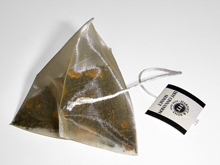
A pyramidal silk teabag of spiced black tea. Pyramidal teabags are a relatively recent innovation. For aficionados, pyramidal bags, which allow more space for larger leaf fragments to steep, have begun to displace the conventional folded, stapled paper teabags, which still dominate the general market. The function of teabags is to contain the tea plant fragments, while permitting tea microparticles and water to pass freely during the brewing process. Containment facilitates removing the tea leaves at the end of the brewing process. One form of failure for a teabag is release of tealeaf matter into the pot or cup. This is the teabag equivalent of something "falling through the cracks."
By analogy with the purpose of teabags, we don't want to stop absolutely everything from falling through the cracks. We don't want to catch and hold every ball. We must be selective. The process described here is one which, if adopted, could lead to indiscriminate acceptance of every responsibility that comes our way, and that could lead to dysfunction even more serious than the problem this process is supposed to address. Some "balls," though tossed in our direction, aren't properly ours to catch. Maintaining (or, if necessary, strengthening) our choice-making skills can be important as we enhance our ability to avoid dropping the ball.
Photo by Shaddack, courtesy Wikipedia.

Has anything ever "fallen through the cracks?" Have you ever "dropped the ball?" Have you ever had a great idea, then lost it, only to remember it later when you would have benefited from it? If this is a familiar pattern, would you like to do something about it? Here's an approach that might reduce the incidence of these misfortunes.
- Gather data
- How often do you actually fail to do something important? How much damage is there? Maybe you remember some horrendous incidents, and you're convinced that there's a problem. But for some, the extent and the consequences of the problem are unclear. To answer these questions, track these incidents over time, possibly weeks or months. One sure sign of a problem: you start tracking and drop the ball on tracking.
- Acknowledge the problem
- Continually dropping the ball or letting things fall through the cracks isn't a path to success. If the data prove that there's a problem, then there's a problem. Fixing the problem begins with acknowledging the problem.
- Recognize that you're the one doing it
- The responsibility for repeated incidents of forgetting important issues lies with one person: the forgetter. Overload can be a cause, but if it is, then the person who's overloaded is the person most responsible for addressing the overload. Either way, the problem is the forgetter's and it's the forgetter's to address.
- Make a contract
- A contract is an agreement between two or more parties. Usually the agreement entails an exchange — one party does (or stops doing) certain things, and in exchange, Continually dropping the ball
or letting things fall through
the cracks isn't
a path to successthe other does (or stops doing) other things. Contracts describe everything from deals between partners to treaties between nations. Contracts can also help us make difficult personal changes. To make this kind of contract, tell someone else about it. Make yourself accountable to someone. If you have no one you can tell, write it down. - Do it
- Make a plan for this change for one category of item that you repeatedly drop. A To Do list usually isn't enough. Most likely you'll need to actually schedule tasks to make them happen. Some trial-and-error might be necessary. Do whatever works for you.
- Do it again
- This is your chance to practice. Find another category of item that you repeatedly drop. Deal with that category. Do the same techniques work for this category? Or did you have to invent some new approach? For items in this category, maybe you have to break them into smaller more doable parts. Or maybe you have to learn how to ask for help. Expand your tool kit. Soon you'll become an expert at not dropping the ball.
Relapses are permitted. Relapses are inevitable. We're all human, and we all make mistakes. And we can learn how to relapse less and less often.  Top
Top  Next Issue
Is your organization embroiled in Change? Are you managing a change effort that faces rampant cynicism, passive non-cooperation, or maybe even outright revolt? Read 101 Tips for Managing Change to learn how to survive, how to plan and how to execute change efforts to inspire real, passionate support. Order Now!
Your comments are welcome
Would you like to see your comments posted here? rbrendPtoGuFOkTSMQOzxner@ChacEgGqaylUnkmwIkkwoCanyon.comSend me your comments by email, or by Web form.About Point Lookout
 Thank you for reading this article. I hope you enjoyed it and
found it useful, and that you'll consider recommending it to a friend.
Thank you for reading this article. I hope you enjoyed it and
found it useful, and that you'll consider recommending it to a friend.
This article in its entirety was written by a human being. No machine intelligence was involved in any way.
Point Lookout is a free weekly email newsletter. Browse the archive of past issues. Subscribe for free.
Support Point Lookout by joining the Friends of Point Lookout, as an individual or as an organization.
Do you face a complex interpersonal situation? Send it in, anonymously if you like, and I'll give you my two cents.
Related articles
More articles on Personal, Team, and Organizational Effectiveness:
 Keep a Not-To-Do List
- Unless you execute all your action items immediately, they probably end up on your To-Do list. Since
they're a source of stress, you'll feel better if you can find a way to avoid acquiring them. Having
a Not-To-Do list reminds you that some things are really not your problem.
 Personal Trade Secrets
- Do you have some little secret tricks you use that make you and your team more effective? Do you wish
you could know what secret tricks others have? Here's a way to share your secrets without risk.
 Inner Babble
- It goes by various names — self-talk, inner dialog, or internal conversation. Because it is so
often disorganized and illogical, I like to call it inner babble. But whatever you call it,
it's often misleading, distracting, and unhelpful. How can you recognize inner babble?
 Teamwork Myths: I vs. We
- In high performance teams, cooperative behavior is a given. But in the experience of many, truly cooperative
behavior is so rare that they believe that something fundamental is at work — that cooperative
behavior requires surrendering the self, which most people are unwilling to do. It's another teamwork myth.
 Wacky Words of Wisdom: V
- Adages, aphorisms, and "words of wisdom" are true often enough that we accept them as universal.
They aren't. Here's Part V of some widely held beliefs that mislead us at work.
See also Personal, Team, and Organizational Effectiveness and Organizational Change for more related articles.
Forthcoming issues of Point Lookout
 Coming May 1: Antipatterns for Time-Constrained Communication: 2
- Recognizing just a few patterns that can lead to miscommunication can reduce the incidence of miscommunications. Here's Part 2 of a collection of antipatterns that arise in communication under time pressure, emphasizing those that depend on content. Available here and by RSS on May 1.
- And on May 8: Antipatterns for Time-Constrained Communication: 3
- Recognizing just a few patterns that can lead to miscommunication can reduce the incidence of problems. Here is Part 3 of a collection of antipatterns that arise in technical communication under time pressure, emphasizing past experiences of participants. Available here and by RSS on May 8.
Coaching services
I offer email and telephone coaching at both corporate and individual rates. Contact Rick for details at rbrendPtoGuFOkTSMQOzxner@ChacEgGqaylUnkmwIkkwoCanyon.com or (650) 787-6475, or toll-free in the continental US at (866) 378-5470.
Get the ebook!
Past issues of Point Lookout are available in six ebooks:
- Get 2001-2 in Geese Don't Land on Twigs (PDF, )
- Get 2003-4 in Why Dogs Wag (PDF, )
- Get 2005-6 in Loopy Things We Do (PDF, )
- Get 2007-8 in Things We Believe That Maybe Aren't So True (PDF, )
- Get 2009-10 in The Questions Not Asked (PDF, )
- Get all of the first twelve years (2001-2012) in The Collected Issues of Point Lookout (PDF, )
Are you a writer, editor or publisher on deadline? Are you looking for an article that will get people talking and get compliments flying your way? You can have 500-1000 words in your inbox in one hour. License any article from this Web site. More info
Follow Rick


Recommend this issue to a friend
Send an email message to a friend
rbrendPtoGuFOkTSMQOzxner@ChacEgGqaylUnkmwIkkwoCanyon.comSend a message to Rick
A Tip A Day feed
Point Lookout weekly feed
 My blog, Technical Debt for Policymakers, offers
resources, insights, and conversations of interest to policymakers who are concerned with managing
technical debt within their organizations. Get the millstone of technical debt off the neck of your
organization!
My blog, Technical Debt for Policymakers, offers
resources, insights, and conversations of interest to policymakers who are concerned with managing
technical debt within their organizations. Get the millstone of technical debt off the neck of your
organization! Bad boss, long commute, troubling ethical questions, hateful colleague? Learn what we can do when we
love the work but not the job.Learn how to make your virtual global team sing.Are you managing a change effort that faces rampant cynicism, passive non-cooperation, or
maybe even outright revolt?Learn how to make meetings more productive — and more rare.
Bad boss, long commute, troubling ethical questions, hateful colleague? Learn what we can do when we
love the work but not the job.Learn how to make your virtual global team sing.Are you managing a change effort that faces rampant cynicism, passive non-cooperation, or
maybe even outright revolt?Learn how to make meetings more productive — and more rare.